
Aluminum alloy is a general term for alloys mainly composed of aluminum, with the addition of alloying elements such as copper, silicon, magnesium, zinc, manganese, as well as nickel, iron, titanium, chromium, lithium, and other elements. While retaining the advantages of pure aluminum such as lightweight, its “strength” can surpass many copper alloys, making it an ideal structural material widely used in mechanical manufacturing, transportation machinery, power machinery, aerospace industry, and other fields.
Compared to pure aluminum, aluminum alloy has significantly improved strength and hardness, although it has lower strength and hardness compared to steel. It requires less cutting force and exhibits good thermal conductivity.
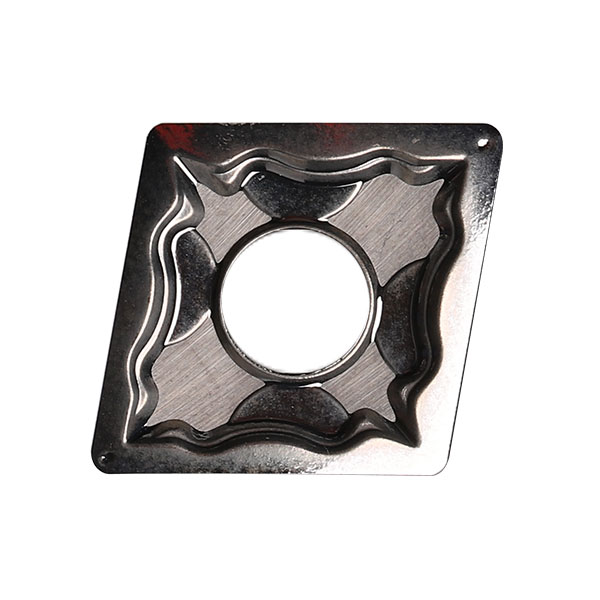
Aluminum alloy has a soft texture and high plasticity, making it prone to chip adhesion during cutting, easily forming built-up edges. During high-speed cutting, the cutting edge may experience welding, leading to a loss of cutting ability and affecting machining accuracy. Therefore, in aluminum alloy processing, cutting tools also show a high level of development and diversification.
Turning machining of aluminum alloy materials:
The inherent mechanical properties and characteristics of aluminum alloy materials can pose challenges in actual production and processing. When turning aluminum alloy materials, the following points should be considered:
- Selecting appropriate tool geometry parameters.
- When machining aluminum alloy materials, the requirements for cutting tools differ from those for other metal materials. The cutting tool should have a large rake angle, large clearance angle, large main relief angle, small negative relief angle, positive rake angle, and a smooth cutting edge.
- During cutting, various physical and mechanical properties of aluminum alloy materials should be fully considered. It is necessary to use small cutting forces for machining and control the temperature to minimize the impact on dimensional measurements during the machining process. Especially when precise dimensional accuracy and surface roughness are required, multiple finishing passes should be employed.


