
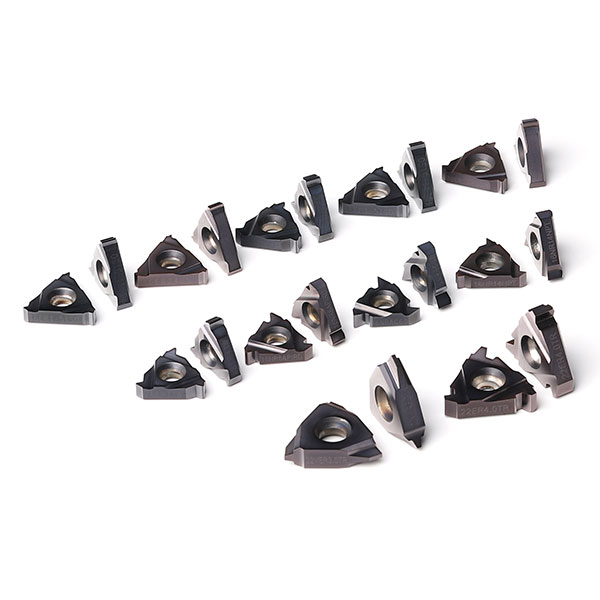
Carbide threading inserts are generally designed around a set of standardized thread forms, and most insert systems don’t “invent” profiles—they conform to international thread standards. What you can cut depends on the insert series and nose geometry, but the common coverage looks like this:
1) 60° V-thread systems (most common)
These are the backbone of carbide threading inserts.
- ISO Metric (M) – ISO Metric Thread
- Used worldwide for metric fasteners
- 60° flank angle
- Unified Thread Standard (UNC / UNF / UNEF) – Unified Thread Standard
- North American standard
- Same 60° geometry as ISO but different pitch series
- NPT / NPTF (taper pipe threads) – National Pipe Taper Thread
- Used for pressure-tight pipe fittings
- Requires taper compensation in the insert system
Most carbide insert lines treat these as the “default family,” often using the same insert shape with different pitch programming.
2) 55° Whitworth-based threads
- BSPP / BSPT (British Standard Pipe) – British Standard Pipe Thread
- 55° flank angle (different from ISO/UN)
- Common in plumbing and hydraulics outside North America
- BSW / BSF (older Whitworth forms)
- Less common in modern machining but still supported in many insert systems
3) Trapezoidal / power transmission threads
Used when strength and motion transfer matter more than fastening.
- ISO Trapezoidal (Tr) – Trapezoidal Thread Form
- 30° flank angle
- Leadscrews, actuators, CNC motion systems
- ACME threads (North American equivalent)
- Similar function, slightly different geometry (29° flank angle)
Many carbide systems require dedicated inserts for these because the profile is not V-shaped.


