
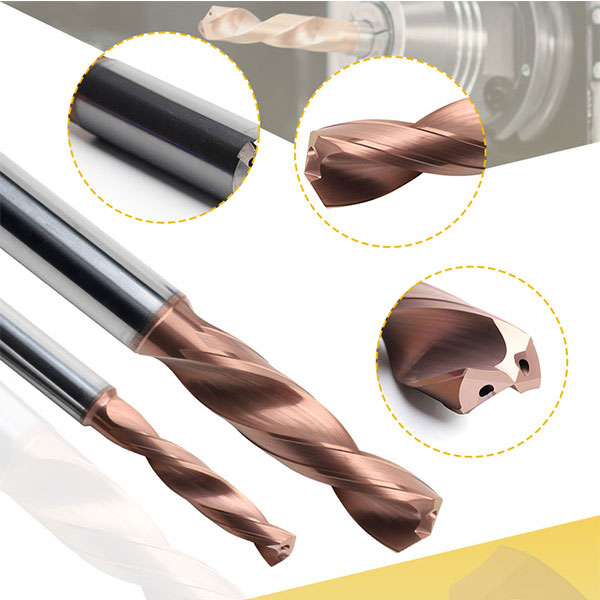
Chatter and vibration during drilling directly cause poor hole dimensional accuracy, rough inner surface, rapid drill bit edge chipping and abnormal tool wear. It also shortens the service life of solid carbide drills and machine tool spindle. Below are practical, factory-proven solutions to suppress drilling vibration effectively.
1. Select Rigid, High-Toughness Carbide Drill Geometry
Choose drills with thick core thickness, reinforced margin land and proper inner coolant hole design. Stepped drills or drills with uneven flute spacing break resonant frequency and eliminate periodic chatter. For deep-hole drilling, adopt drills with chip split point to reduce cutting resistance fluctuation. Avoid overly long, slim micro drills for deep holes if machine rigidity is insufficient.
2. Optimize Cutting Parameters to Stay Away from Resonance Zones
Excessively high spindle speed easily hits the natural vibration frequency of the tool-workpiece system. Adjust RPM step by step to skip obvious noisy resonant speed ranges. Reduce overhigh feed rate that brings heavy fluctuating cutting force. For hard materials or long overhang drilling, lower cutting speed moderately and use stable moderate feed to smooth cutting load.
3. Improve Workpiece Clamping and Fixture Rigidity
Loose clamping is one major root cause of chatter. Use sturdy vises, hydraulic chucks or custom jigs for firm fixation. Add support backers for thin-walled rings, slender shafts and hollow parts to stop workpiece bouncing during cutting. Avoid cantilever mounting with large overhang on the workpiece side.
4. Enhance Tool Holding System Stability
Use high-precision hydraulic chucks, shrink-fit holders or anti-vibration drill chucks instead of ordinary ER collets with poor concentricity. Keep the tool clamping length as short as possible to minimize tool overhang. Ensure the holder taper and spindle taper are clean and fully fitted without gap, which avoids radial runout-induced vibration.
5. Control Chip Evacuation and Reduce Intermittent Cutting Load
Poor chip blocking creates irregular cutting force that triggers vibration. Use through-coolant drills for efficient chip removal. For deep holes, apply peck drilling cycles to break long chips periodically. Polished flute surfaces lower chip friction resistance and make cutting load more continuous and stable.
6. Machine Tool and Process Auxiliary Improvements
Check spindle runout, bearing clearance and guideway preload regularly to guarantee equipment basic rigidity. Apply sufficient cutting fluid to lower cutting temperature and reduce friction-induced stick-slip vibration. For extremely unstable conditions, use carbide drills with vibration-damping internal structures or add vibration-damping tool bars.
Eliminating drilling chatter relies on the combination of rigid drills, matched cutting data, reliable clamping and stable holders. Our solid carbide drills for steel, stainless steel and cast iron adopt anti-vibration flute design to achieve smooth drilling performance. Contact our technical team for recommended drilling parameters for your material and hole depth.


